← All Writing
What Happens When AI Gets There First?
AI is beginning to produce scientific discoveries faster than researchers can evaluate them. As machines generate mathematical proofs and uncover new knowledge, an uncomfortable question emerges: If AI can find the answers before we do, what happens to the human pursuit of understanding? The future of discovery may depend less on who gets there first and more on who determines what those discoveries mean.
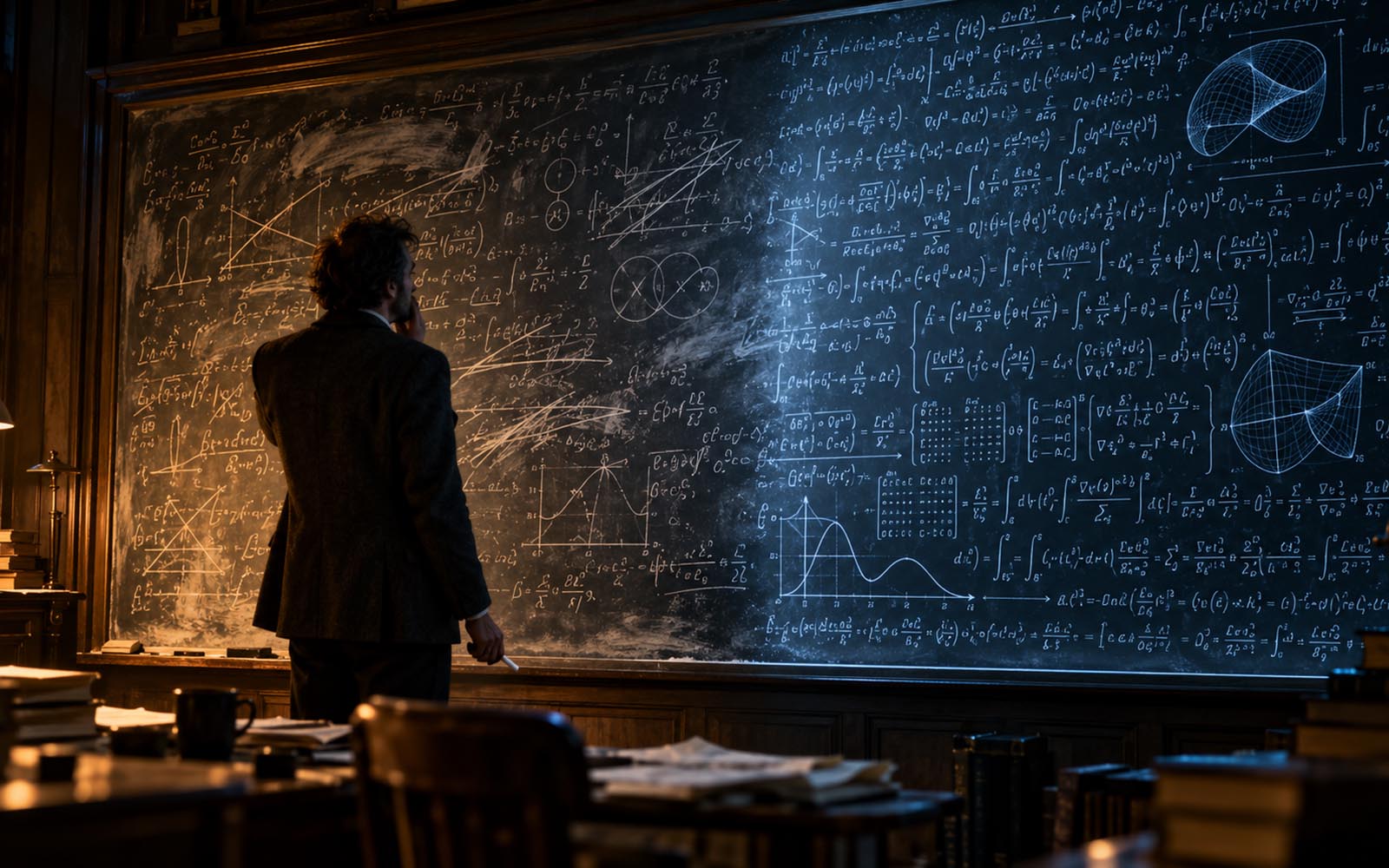
What Happens When AI Gets There First?
The difference between producing knowledge and understanding what it means.
The Discovery That Arrived Before the Scientist
Imagine spending years working on a mathematical problem. You study the existing research, test approaches that lead nowhere, refine your thinking, and gradually move toward something you believe might be a genuine discovery. Then, before you publish, an AI system announces a similar result.
For some researchers, that possibility is no longer hypothetical.
Recent controversies in mathematics have raised questions about scientific priority, attribution, and what happens when AI systems reach results that human researchers have spent years pursuing. On October 6, 2026, OpenAI released hundreds of AI-generated mathematical manuscripts, presenting a glimpse of a future in which machines contribute to discoveries at a pace human researchers may struggle to match.
But producing a mathematical result is not the same as establishing its significance. A proof can be generated, even formally checked, without the broader research community having independently evaluated its novelty, understood its implications, or determined how it fits into existing knowledge.
That distinction matters because science has never been simply about accumulating answers. It is also about understanding why those answers matter.
And it raises a question we may soon find ourselves unable to avoid:
What happens when generating knowledge becomes faster than humanity's ability to understand it?
Discovery Has Always Been a Human Achievement
Scientific discovery has never been simply about finding the right answer. It begins with curiosity, with someone looking at the world and wondering why something works the way it does. That curiosity leads to questions, experiments, failed assumptions, revised theories, and occasionally, breakthroughs that change how we understand reality.
We attach names to discoveries because we recognize something meaningful in that process. Newton, Darwin, Einstein, and countless others are remembered not merely for their conclusions, but for the intellectual work that made those conclusions possible. Recognition also matters professionally, influencing careers, funding, and opportunities to pursue further research.
Of course, science has never been the achievement of isolated geniuses working alone. Every discovery builds upon generations of accumulated knowledge, collaboration, institutional support, and often the unrecognized contributions of others.
But throughout that process, human inquiry has remained central. Someone asks the question, struggles with uncertainty, interprets the evidence, and explains why the result matters.
What happens when that process begins producing answers without requiring the same human effort that once defined the achievement?
The Machine Has an Answer. Now What?
On October 6, OpenAI released hundreds of mathematical manuscripts generated by an internal AI model. A week later, Stanford researchers introduced CausalSmith, a system designed to propose and verify new theorems in causal inference.
These developments represent a shift in how AI participates in research. Rather than simply summarizing existing knowledge or assisting with documentation, AI systems are beginning to generate mathematical arguments and investigate problems themselves.
An important part of that process involves tools such as Lean, a formal proof assistant that allows mathematical statements and their proofs to be expressed in a language computers can check. When a proof is correctly formalized, Lean can verify that its logical steps follow from the stated assumptions.
This matters because generative AI systems can produce convincing but incorrect explanations. Formal verification offers a way to check mathematical reasoning rather than relying on the model's confidence or presentation.
But there are limits. Verification doesn't establish that a theorem is novel, that its formal statement captures the intended claim, or that the result represents an important advance.
The technology is becoming capable of producing research that once required substantial human intellectual effort. Whether those outputs become meaningful contributions to mathematics depends on what happens after they're generated.
When Being First Stops Being Enough
Recent reporting in Nature describes researchers confronting an uncomfortable possibility: AI systems reaching mathematical results before the scientists who have spent years pursuing them.
Consider mathematician Tristan Buckmaster, who, alongside collaborator Levent Alpöge, had been working on a version of the Navier–Stokes problem. In September, Buckmaster publicly shared progress on their research. The following day, OpenAI announced that its agents had solved a related problem. Buckmaster questioned the timing, although OpenAI disputed suggestions that his unpublished work had influenced its system.
The controversy illustrates something beyond a competition to solve a mathematical problem. In academic science, publication priority influences reputation, funding, career advancement, and the opportunities researchers receive to continue their work.
For an established mathematician, losing recognition can be frustrating. For an early-career researcher whose future depends on demonstrating original contributions, the consequences could be considerably greater.
Yet the scientific result itself doesn't become less valuable because a machine produced it. A valid discovery may still advance an entire field, regardless of who reached it first.
That creates a difficult tension. Scientific progress can benefit from faster discoveries even as the people who dedicate their lives to making them find their contributions harder to distinguish.
If the result matters regardless of who produces it, what happens to the human meaning of having discovered it?
Correct Isn't the Same as Understood
Mathematical validity establishes whether a conclusion follows logically from its assumptions. Scientific understanding requires something more: recognizing how a finding relates to existing knowledge, what assumptions shape its usefulness, and which questions it makes possible to investigate next.
A correct proof might resolve a problem while revealing little about the broader principles behind it. Researchers may need months or years to develop explanations that connect an unfamiliar result to the rest of their field.
The Advisory Group on Mathematics and Artificial Intelligence, whose members include prominent mathematicians, has raised concerns about how AI-generated mathematical results are released and incorporated into research. Its recommendations emphasize that making proofs available is not enough. The mathematical community must also have the resources and opportunity to examine, explain, and build upon them.
This creates a potential problem of scale.
Imagine AI systems producing thousands of verified mathematical results while researchers can thoroughly investigate only a fraction of them. Some could be significant breakthroughs. Others might be minor variations of existing work. Determining which deserve attention could become an enormous research effort of its own.
Scientific output would increase, but that wouldn't guarantee a corresponding increase in scientific understanding.
The challenge is already prompting a response. On October 15, OpenAI announced a $5 million contribution to a Simons Foundation initiative supporting mathematicians working to examine, understand, and build upon AI-generated results. The investment acknowledges something important: producing discoveries is only part of scientific progress. Helping people understand them requires resources of its own.
The bottleneck hasn't disappeared. It has moved from producing answers toward determining which answers matter and why.
There Is a Strong Argument for Letting AI Discover
For all the concerns surrounding AI-generated research, there is a compelling argument in its favor. Why should it matter whether a human or a machine discovers a new medical treatment, solves a difficult mathematical problem, or identifies a more efficient way to produce clean energy?
The benefits don't disappear because the discovery came from a machine.
There is no inherent virtue in a scientific breakthrough taking decades instead of days. Every year spent pursuing an unanswered question represents time in which its potential benefits remain unrealized. If AI can accelerate that process, refusing to use it simply to preserve human recognition would be difficult to justify.
And AI could do more than accelerate existing research. It might uncover relationships humans have overlooked or open entirely new directions of scientific inquiry.
But acknowledging those possibilities doesn't mean abandoning the human role in discovery.
The challenge isn't deciding whether machines should help us discover more. They should.
The challenge is ensuring that the institutions producing this knowledge still give humans meaningful authority over which questions deserve answers, how discoveries are understood, and what we ultimately choose to do with them.
The Scientist May Not Disappear. The Role May Change.
As AI systems become more capable of generating mathematical results and proposing hypotheses, scientists may increasingly concentrate on designing experiments, challenging findings, connecting discoveries, and identifying questions worth investigating.
That sounds reassuring. The machines handle more of the technical work, leaving humans to guide the direction of research.
But there is a problem with assuming that arrangement will emerge naturally.
The Advisory Group on Mathematics and Artificial Intelligence has warned about unequal access to advanced AI systems, emphasizing that mathematicians must retain the freedom to formulate their own research questions rather than having their work directed by AI laboratories. If a small number of companies control the most capable research tools, those companies could gain significant influence over which problems receive attention, who can investigate them, and which discoveries become publicly available.
A scientist might still review results without having meaningful influence over the questions being pursued. They might interpret findings without access to the systems or resources needed to challenge them.
The issue is not whether scientists continue to have jobs or participate in research. It is whether they retain the authority and independence necessary to shape its direction.
That distinction matters because participation alone doesn't guarantee influence.
Human involvement cannot become a ceremonial step in a process increasingly controlled elsewhere.
If scientific discovery is changing, the institutions surrounding it must ensure that researchers can do more than validate decisions already made on their behalf.
Discovery Was Never Just About the Answer
Consider again the researcher who spent years pursuing a discovery, only to watch an AI system arrive at a similar result first.
The mathematics doesn't become less correct because a machine produced it. The discovery may still advance science, inspire further research, or eventually improve people's lives. We shouldn't confuse the loss of human recognition with the loss of scientific value.
But we also shouldn't confuse producing answers with the entire purpose of scientific inquiry.
Discovery has always involved deciding what deserves investigation, questioning what we believe to be true, and struggling to understand a world that rarely provides simple explanations. Those activities matter independently of who reaches a particular conclusion first.
As AI becomes more capable, we may need to reconsider where human contributions belong in that process. But we cannot assume those contributions will remain meaningful simply because we insist that humans should stay involved.
People need the ability to ask questions, challenge findings, interpret consequences, and influence what happens next. Without that participation, human understanding risks becoming an afterthought.
The troubling possibility isn't that machines will discover things before we do. It's that we might become so satisfied with having the answers that we stop asking what understanding them was for.
References
-
OpenAI. (2026, October 6). Sharing AI progress in mathematics. https://openai.com/index/sharing-ai-progress-in-mathematics/
-
OpenAI. (2026). Mathematical research repository [GitHub repository]. GitHub. https://github.com/openai/math
-
Glickman, K. (2026, October 8). Will AI scoop your science? Some researchers see a gloomy future. Nature. https://www.nature.com/articles/d41586-026-03128-6
-
Stanford Artificial Intelligence Laboratory. (2026, October 13). CausalSmith: A formally grounded, self-improving agentic framework. https://sail.stanford.edu/blog/causalsmith/
-
Advisory Group on Mathematics and Artificial Intelligence. (2026, September 29). Responsible release of AI-generated mathematics. https://agmai.org/general-sep29/
-
Advisory Group on Mathematics and Artificial Intelligence. (2026, October 6). Statement on OpenAI's mathematical research release. https://agmai.org/statement-oct6/
-
Nature. (2026, September 16). AI companies must work with the research community to protect attribution. https://www.nature.com/articles/d41586-026-02886-7
-
Braun, R. (2026, September 1). Who is responsible when AI helps to write science? Nature. https://www.nature.com/articles/d41586-026-02686-z
-
CERN. (2026, October 15). CERN and Mistral join forces to accelerate AI for science. https://home.cern/cern-and-mistral-join-forces-to-accelerate-ai-for-science/
Join the Conversation
What do you think? As AI becomes more capable of making discoveries, will it change how we value human knowledge and understanding? I'd love to hear your perspective.
Leave a comment below and join the conversation. And be sure to come back every Thursday for new articles exploring AI advancements, emerging technologies, and what they mean for our future.
The Conversation
Comments
Loading comments...
Join the Conversation
Leave a comment.
I read every comment. Comments are reviewed before appearing publicly.